
India's IT services industry is witnessing a surge in mergers and acquisitions, particularly among mid-cap companies, as AI-led pricing pressure and macroeconomic uncertainty compel firms to seek scale, capabilities, and broader market reach. This trend is exemplified by the recent merger of Happiest Minds Technologies and ITC Infotech, aiming to offer end-to-end solutions and compete for larger transformation programmes.

The benchmark Sensex plummeted 813 points to a three-month low, with the Nifty settling below 23,450, as escalating tensions in West Asia drove crude oil prices above USD 100 per barrel, leading to widespread selling in IT, FMCG, financial services, and oil & gas shares.

Indian benchmark equity indices, Sensex and Nifty, rebounded after a two-day losing streak, driven by strong buying in blue-chip IT stocks and positive global market cues, with the Sensex climbing 330.92 points.

Indian information technology (IT) stocks, led by Infosys, experienced a significant selloff, dragging the Nifty to a two-month low, primarily due to escalating West Asian tensions pushing crude oil prices higher, and concerns over upcoming large IPOs diverting funds from secondary markets. The sector is also grappling with the long-term implications of AI disruption.

Indian benchmark indices Sensex and Nifty experienced significant declines in early trade, driven by soaring crude oil prices amidst escalating tensions in West Asia, coupled with weak global market trends and foreign fund outflows.

SEBI Chairman Tuhin Kanta Pandey stated that the National Stock Exchange (NSE) has not submitted any proposal seeking approval to trade on its own platform after getting listed, and such trading is currently not permitted. He also confirmed that SEBI would examine concerns raised by brokers and asset management companies regarding the new UPI Merchant Discount Rate (MDR) framework.

Indian benchmark equity indices, Sensex and Nifty, rebounded in early trade after two days of losses, driven by strong buying in blue-chip IT stocks and a rally in global markets.

'Since the category has a limited track record, assess the fund manager's experience across equity and debt market cycles rather than relying only on past returns.'

Indian benchmark indices Sensex and Nifty experienced a significant slump in early trade, mirroring a bearish trend in global equities, as escalating conflict in West Asia drove up crude oil prices and intensified investor concerns.

Indian benchmark indices, Sensex and Nifty, experienced declines in early trade due to elevated crude oil prices, escalating US-Iran hostilities, and renewed concerns over a potential US interest rate hike.

Indian stock market benchmark indices Sensex and Nifty closed nearly one per cent higher, extending their winning streak for a second day. This rally was driven by softening crude oil prices, positive geopolitical developments, and significant buying in blue-chip IT stocks, despite a broader global tech sell-off.

Analysts predict that geopolitical developments, particularly surrounding the Strait of Hormuz and the US-Iran standoff, along with crude oil prices, will be the primary factors influencing stock market movement in the coming week. Investors will also monitor foreign institutional flows and the Federal Open Market Committee (FOMC) minutes for signals on the Federal Reserve's policy outlook.
Indian stock markets, including the Sensex and Nifty, experienced a significant tumble in early trade, driven by escalating tensions in West Asia that pushed crude oil prices close to the USD 100-per-barrel mark, alongside selling in IT stocks and fresh foreign fund outflows.

Investors opening new brokerage accounts must choose a broker suited to their style.

Indian benchmark indices Sensex and Nifty opened higher, driven by a significant drop in crude oil prices and a positive trend in global equities, with foreign fund inflows further bolstering domestic markets.

Analysts predict that crude oil prices and the ongoing US-Iran conflict will be the primary drivers of stock market movements, with investors also closely watching the Jackson Hole symposium for cues on interest rates.

Indian stock markets, including the Sensex and Nifty, rebounded significantly, driven by a decline in crude oil prices and positive global cues stemming from hopes of diplomatic progress in US-Iran negotiations.
Indian benchmark indices Sensex and Nifty experienced declines in early trade, influenced by the escalating US-Iran standoff and persistently high crude oil prices, with experts predicting increased volatility.

IT services stocks have had tough two years, with prices coming under pressure from 2025 and the sell-off extending through the first half of 2026.
Indian benchmark equity indices, the Sensex and Nifty, bounced back significantly, with the Sensex climbing 628 points and the Nifty snapping its seven-day losing streak, driven by easing global bond yields and fresh foreign fund inflows.
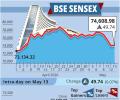
Indian benchmark equity indices, Sensex and Nifty, closed marginally higher, breaking a four-day losing streak, despite elevated crude oil prices and ongoing geopolitical uncertainties. The market saw a temporary pause in panic selling, though cautious sentiment persists.

Analysts predict that the Indian stock market's sentiment this week will be primarily influenced by the domestic GDP data announcement, crude oil prices, and the crucial US non-farm payrolls report.

Indian benchmark equity indices, Sensex and Nifty, traded marginally higher in early deals despite cautious global cues stemming from elevated crude oil prices due to geopolitical uncertainties and a sharp fall in US markets. Track Sensex, Nifty on August 21, 2026.
Indian benchmark equity indices, Sensex and Nifty, rebounded in early trade, driven by a recovery in world markets due to easing US Treasury yields and fresh foreign fund inflows, halting a multi-day losing streak. Track Sensex, Nifty on August 20.

Indian benchmark indices, Sensex and Nifty, saw declines in early trade, influenced by rising crude oil prices and ongoing geopolitical tensions in West Asia. Experts suggest that crude oil remains a primary concern, with Brent holding near USD 88 a barrel due to renewed US warnings against Iran, embedding a geopolitical risk premium in energy markets. Track Sensex, Nifty

Indian benchmark indices, Sensex and Nifty, experienced a sharp decline at the close of trade, with the Sensex dropping 539 points and the Nifty falling below 24,100, primarily due to selling pressure in HDFC Bank and ongoing geopolitical uncertainties.

Net investments into equity mutual fund schemes in India remained elevated at approximately 38,440 crore in April, despite a slight dip from March's high and a 3% month-on-month decline in Systematic Investment Plan (SIP) inflows.
Indian stock markets closed lower due to selling in IT and FMCG shares, triggered by renewed tensions in West Asia which led to a rally in crude oil prices and concerns over inflation and interest rates.

Indian benchmark indices closed mixed, with the Sensex gaining 113.61 points to 78,079.96 and the Nifty falling 40.10 points to 24,395.85, as elevated crude prices and ongoing geopolitical uncertainty in the Middle East made investors cautious.
Indian benchmark indices closed mixed, with the Sensex gaining 113.61 points to 78,079.96 and the Nifty falling 40.10 points to 24,395.85, as elevated crude prices and ongoing geopolitical uncertainty in the Middle East made investors cautious.
Indian benchmark indices, Sensex and Nifty, closed marginally lower due to elevated crude oil prices, fresh US-Iran tensions, and expectations of a tighter monetary policy from the US Federal Reserve, despite strong domestic GDP growth.
Indian benchmark indices, Sensex and Nifty, continued their downward trend for the fifth consecutive day, with the Sensex dropping 281 points and Nifty falling 78 points, primarily driven by surging crude oil prices and persistent geopolitical tensions in West Asia.

Smallcap and midcap funds now account for nearly 30% of active equity MF folios, as stock-market gains revive investor appetite for high-growth segments.

Many investors are working hard as their own fund managers, unaware whether their efforts have actually rewarded them for the job.

Indian benchmark indices, Sensex and Nifty, closed almost flat in choppy trade as investors remained cautious due to ongoing uncertainty in West Asia, relentless foreign fund outflows, and anticipation of the RBI's monetary policy decision.

Indian benchmark indices Sensex and Nifty closed lower, with the Sensex dropping 388 points and Nifty declining 112 points, as a sharp rally in crude oil prices, driven by geopolitical uncertainties and concerns over the Strait of Hormuz, dampened investor sentiment and reignited inflation fears.

'Every period of excessive optimism eventually gives way to a correction, while periods of extreme pessimism often create the best investment opportunities.'

The combined market valuation of four of India's top-10 most valued firms eroded by Rs 87,960.29 crore last week, with Bharti Airtel experiencing the largest decline, amidst a bearish trend in the equities market.

Indian benchmark indices, Sensex and Nifty, recovered intraday losses to close higher, driven by late-day buying and a significant decline in Brent crude oil prices, which fell 3 per cent to USD 89.32 per barrel.

Chinese President Xi Jinping addressed the BRICS summit, urging the bloc to play a significant role in achieving peace and tranquillity in West Asia and the Gulf region. He highlighted BRICS' growth over two decades, its efforts in tackling global challenges, and its steadfastness in safeguarding the interests of the Global South. Xi called for opposing the Cold War mentality, strengthening multilateralism, and promoting cooperation in emerging domains like AI, as China prepares to chair the next summit.
